
Climbing Mount Kazbek - The Complete 2026 Guide
Everything you need to know before you set foot on Georgia’s most iconic 5000-meter peak — from first steps in Tbilisi to the summit at dawn.
- Altitude — 5,054 m
- Season — July – Sept
- Duration — 6 – 8 days
- Grade — PD / AD
- Success rate — 70 – 85%
Why Kazbek?
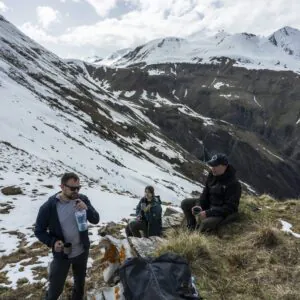
Mount Kazbek is one of the most accessible 5000-meter peaks on the planet — and one of the most beautiful. Perched on the Georgian-Russian border deep in the heart of the Greater Caucasus, it offers a genuine high-altitude mountaineering experience without the price tag or the crowds of the Alps or Elbrus.
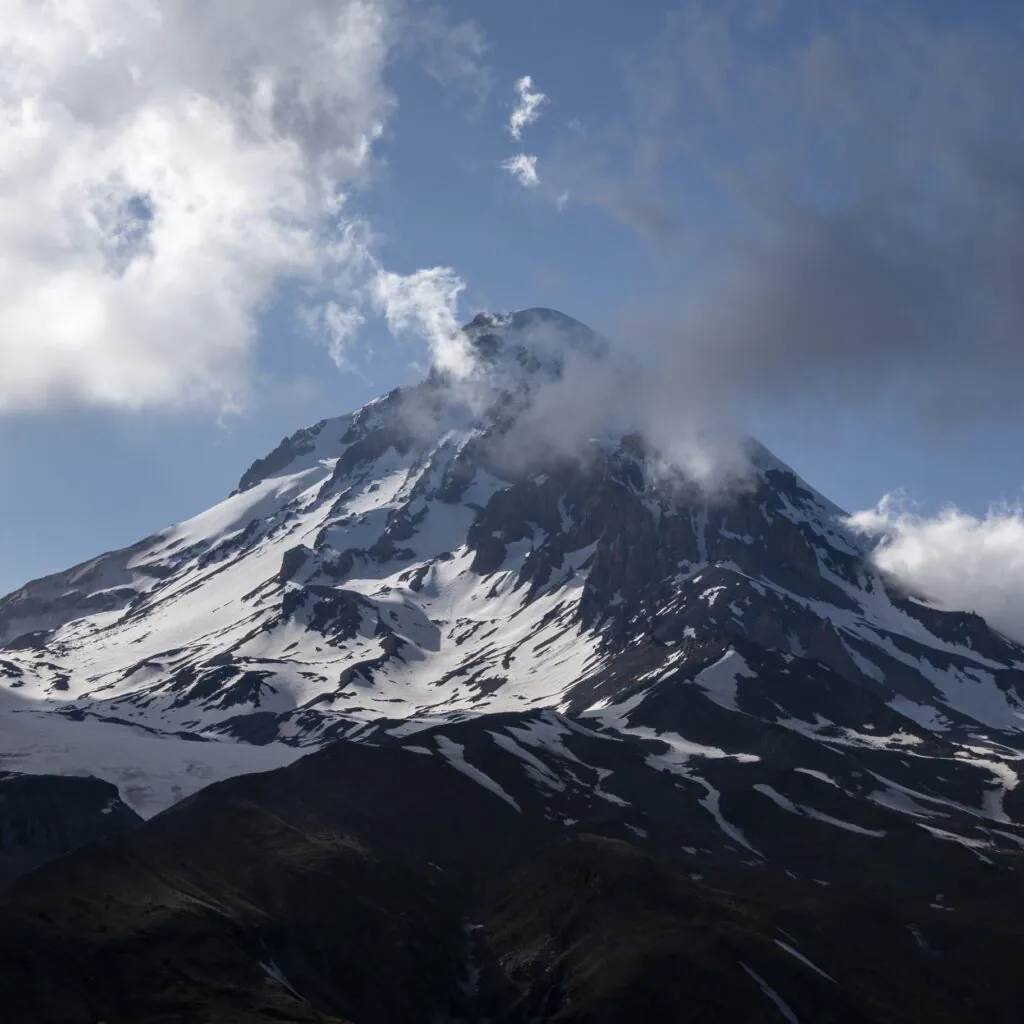
The standard route crosses the Gergeti Glacier, passes a historic Soviet-era weather station at 3600 meters, and winds up a 35–40° snow slope to the summit pyramid. From the top, you see the full arc of the Caucasus range, the Gergeti Trinity Church far below, and — on a clear day — the white cone of Elbrus to the west.
Unlike Mont Blanc or Kilimanjaro, Kazbek remains genuinely uncrowded. In peak season, the mountain hosts perhaps 50–100 climbers, not hundreds. The base town of Stepantsminda (Kazbegi) is charming, well-connected, and three hours by road from Tbilisi International Airport. Logistics here are simple. The mountain is not.
Is this climb for you?
Kazbek is not a trekking peak. It is not a technical alpine climb either. The honest answer sits somewhere between — a serious high-altitude objective that demands basic glacier skills, solid fitness, and genuine respect for the altitude.
Technical difficulty
You need crampons, an ice axe, and the ability to walk roped up on a glacier. The route includes a traverse below the summit and a final 35–40° snow ridge. No rock climbing. No vertical ice. Prior 5000m experience is not required.
Physical demands
Summit day starts at 2 AM and lasts 10–14 hours. You gain 1400 vertical meters from the weather station at 3600m to the top. The fitness benchmark: can you hike 1000m of vertical gain with a 10 kg pack in a day without stopping every 10 minutes?
Training recommendation (6–8 weeks out)
Hike with a 10–12 kg pack twice a week. Add stair climbs for 30–45 minutes at pace. One long day hike per week with elevation gain. Leg strength: squats, lunges, step-ups. Your guide’s pacing on the day matters more than any training regime — but preparation makes the experience far more enjoyable.
Read also reviews about climbing Kazbek.
Day by day, from Tbilisi to the top
D1. Tbilisi → Kazbegi (1740 m)
D2. Acclimatization hike to 2500 m
D3. Hike to the weather station (3600 m)
D4. Glacier training + acclimatization to ~4000 m
D5. Rest and summit preparation
D6. Summit day 5054 m
D7. Descent to Kazbegi
D8. Return to Tbilisi
Acclimatization and altitude sickness
Altitude sickness is the single greatest risk on Kazbek. The acclimatization schedule above is carefully designed — two nights at 1740m, progressive time at 3600m, a high day to 4000m, then the summit push. It works for 85% of people in normal health with reasonable fitness.
Know the warning signs
- Mild AMS: headache, nausea, poor sleep, loss of appetite. Treat with rest and hydration at the same altitude.
- Moderate AMS: vomiting, worsening headache, unsteady gait. Descend at least 500m immediately.
- Severe AMS / HAPE / HACE: confusion, breathlessness at rest, loss of coordination. This is a medical emergency — descend now. No summit is worth your life.
Diamox (Acetazolamide) can speed acclimatization. A common dose is 125–250mg twice daily, starting 24 hours before altitude gain. Side effects include tingling fingers and a metallic taste. Consult your doctor; guides advise but do not prescribe. The weather station carries an oxygen cylinder for emergencies. Guides carry comprehensive medical kits.
What to bring and what’s provided
Your booking includes all group technical equipment. You bring your own clothing and personal items. The list below is not optional — the summit sits at 5054m with temperatures of −10°C to −20°C and real wind. Here’s what to take with you.
- Crampons (fitted to your boots)
- Ice axe
- Climbing harness
- Helmet
- Carabiners & slings
- Group rope
- Double-layer mountaineering boots rated to −20°C
- Examples: Scarpa Phantom, La Sportiva G2 SM, Mammut Nordwand
- Regular hiking boots are not suitable above 3600m
- Rental available from Tbilisi — ask in advance
- Merino or synthetic base layer (no cotton)
- Mid-layer fleece or thin down jacket
- Waterproof shell jacket and shell pants
- Heavy down/belay parka for summit day
- Thermal leggings
- Liner gloves + waterproof mittens (two pairs)
- Glacier glasses (cat. 3–4) + ski goggles
- Fleece beanie or balaclava
- Headlamp with fresh batteries
- Sleeping bag rated to −10°C
- 10,000+ mAh power bank
- SPF 50 sunblock + lip balm with SPF
Customer Reviews
EXCELLENTBased on 70 reviews Trustindex verifies that the original source of the review is Google.
 Nikita Chesnokov2025-10-20Any trip with PVD was a true adventure to remember for me! I've had 4 of them already, including one 1-week hiking trip, and really looking forward for more in the future.Trustindex verifies that the original source of the review is Google.
 Сергей Ф2025-10-14Классные ребята. Много куда с ними ходил за последние два года: Джута, озера Абуделаури, озеро Удзиро, Тушетия и восхождения на Орцвери и на Казбек.Trustindex verifies that the original source of the review is Google.
 Aleksei Azarov2025-09-16Отличный оператор различных туров по Грузии и не только. Ездил с ними несколько раз в Гудаури, Бахмаро, Тушети и каждый раз получал от поездки больше чем ожидал. Организаторы общительные, но не навязчивые, готовы помочь в случае каких либо трудностей, подсказать, дать совет, поддержать и вписаться в веселую затею, а также реализовать какую-нибудь нестандартную хотелку, вроде дать в аренду оборудование и проводить скитуром волн на ту гору. Для меня эти ребята - лучшее соотношение цены и качества и я точно планирую съездить с ними ещё не раз.Trustindex verifies that the original source of the review is Google.
 Кристина Кужаль2025-09-15Ходила с ребятами на Казбек - это восхождение останется в сердце навсегда! Спасибо гиду - Глеб, ты невероятный! Всё четко организовано, слажено. Атмосфера дружелюбная и веселая, но при этом все, что касается безопасности и временных лимитов - строго и четко. А еда! Ммммм... одно какао на высоте 3653 м чего только стоит! Всегда были накормлены, проинструктированы, помощь и поддержка от гида была всегда. Первый мой поход, где абсолютная уверенность в гиде и команде вселяла личную уверенность. Было интересно, захватывающе, местами непросто, но абсолютно комфортно, спокойно, безопасно и весело) Спасибо!))Trustindex verifies that the original source of the review is Google.
 Dmitry Drozd2025-09-06Когда следующий тур, ребята? После успешного восхождения на Казбек нужно обязательно сделать еще несколько) Гид Глеб решал в процессе любые вопросы, четко определил погодное окно для восхождения и наша группа была первая на горе. Это мелочь, но это важно! В общем до встречи! Я в восторге от организации тура!Trustindex verifies that the original source of the review is Google.
 Сергей Иодо2025-09-04Спасибо вашей команде за незабываемое восхождение на Казбек! Всё было идеально организовано, гид суперпрофи, поддерживал и мотивировал на каждом шагу. Мы взошли на вершину и получили массу невероятных эмоций!Trustindex verifies that the original source of the review is Google.
 Yana Savischeva2025-08-22Путешествовали семьёй и брали у ребят машину. Всё прошло отлично: автомобиль в хорошем состоянии, никаких проблем не возникло. Коммуникация была быстрой и приятной. Остались только положительные впечатления. Рекомендуем! :)Showing only 4-5 star reviews
When to go
The main climbing season runs July through mid-September. Outside these months the weather is too unstable and crevasse cover deteriorates significantly.
July offers the highest summit success rates, stable weather, and excellent snow conditions on the glacier. August is the most consistent month overall — daytime temps at basecamp reach 5–10°C, nights drop to −5–10°C, and the summit expects −10–20°C with wind.
Early September sees fewer climbers, often clearer views, but increasingly variable conditions. Rain above 3500m is rare; the primary hazard is wind and cloud on summit day. If wind exceeds 50 km/h or visibility drops, the summit push is delayed — the guide’s call is final.
See all tours and programs for climbing Kazbek in this article.
Cost breakdown
- Guided program (groups of 6–8)from $650 pp
- Gear rental (boots, sleeping bag if needed)$50 – 100
- Guesthouse accommodation in Kazbegi$20 – 40 / night
- Meals in town$10 – 20 / day
- Weather station food (snacks, instant meals)~$25
- Mountaineering travel insurance$30 – 80
- Guide tip (optional, customary)$50 – 100
For comparison: guided Elbrus climbs run $1800–3000; Mont Blanc $2500 and up. Kazbek is one of the best-value high-altitude mountaineering experiences available anywhere in the world. For more information on climbing prices for Kazbek, see the article.

Kazbek vs other 5000m peaks
Peak | Height | Technical level | Cost | Verdict |
Kazbek | 5054 m | Glacier, crampons, 40° slopes | from $650 | Best first glacier peak; uncrowded; superb value |
Elbrus | 5642 m | Lower (cable cars assist) | $1800–3000 | Higher, more infrastructure, less authentic |
Mont Blanc | 4808 m | Higher — rock + crevasses | $2500+ | A step up technically; very crowded |
Kilimanjaro | 5895 m | Trail hike, no glacier skills | $2000–3500 | Trekking peak only; no glacier experience |
Damavand | 5671 m | Non-technical volcanic hike | Varies | Iran visa logistics; gas vents near top |


