
Ski Touring in Goderdzi: Powder, Forest and Empty Slopes
Goderdzi is the answer to a question Georgian riders ask each other every winter: where do you go when Gudauri is tracked out and you still want fresh lines? Our freeride guide to Gudauri is the counterpart if you want to compare terrain.
The resort sits in Adjara, on the Goderdzi pass, and it’s small — a handful of lifts, a couple of hotels, and an enormous amount of terrain that nobody is skiing. For tourers, that’s the appeal. You skin from the road, you pick a line through beech forest, and you don’t see another group all day.
It’s also a different mountain from the Caucasus in almost every way that matters. Wetter, lower, denser, and quieter. Understanding that difference is the key to enjoying it.
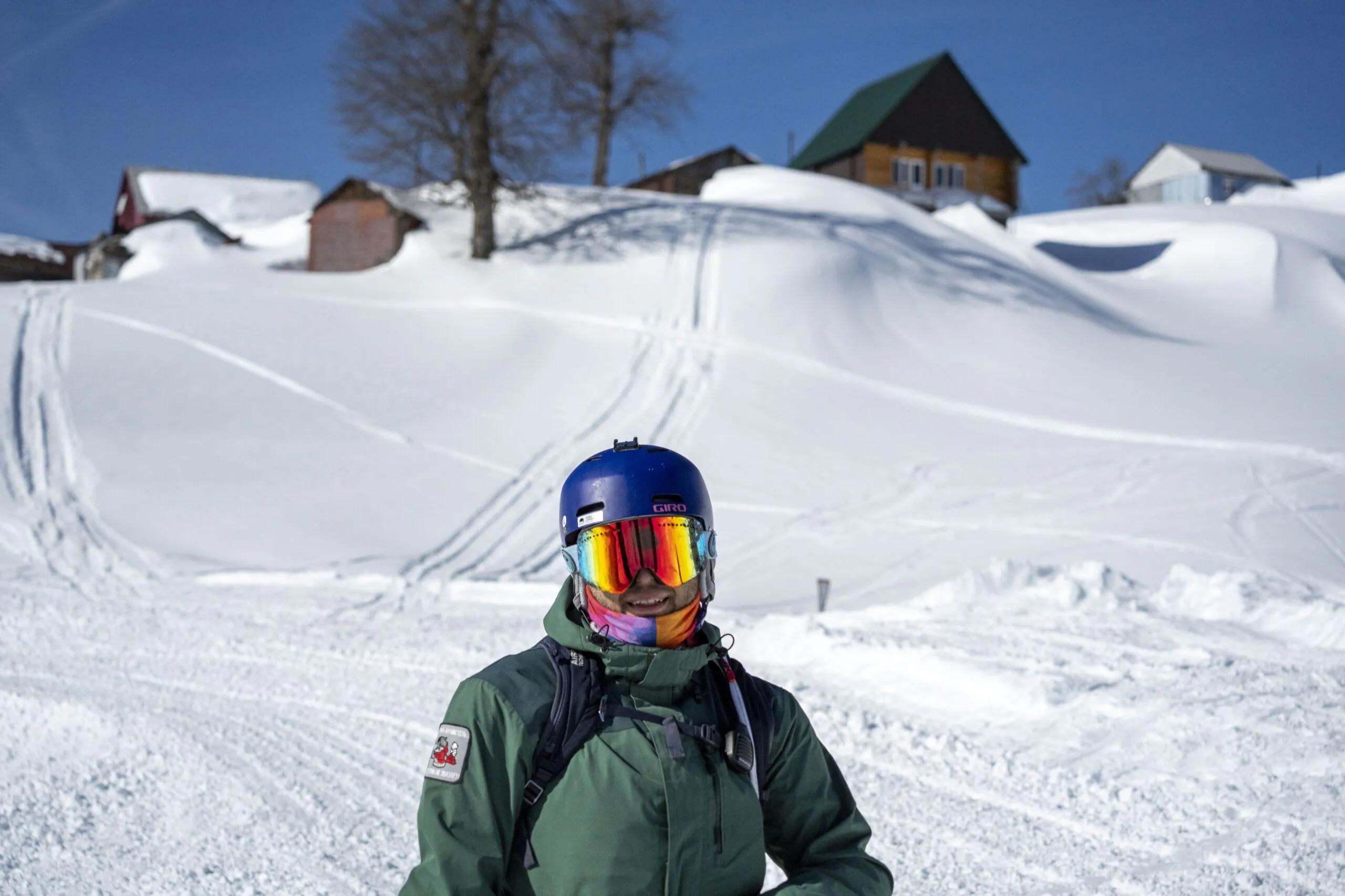
Where Goderdzi Is and How to Get There
Goderdzi is about three to four hours from Batumi, depending on road conditions, and considerably longer from Tbilisi — seven hours or more in winter, with a long stretch of mountain road that demands attention. The pass tops out around 2,000 metres and the resort base sits just below it.
The usual approach is from Batumi, up the Adjaristskali gorge through Khulo. It’s a spectacular road and a slow one: hairpins, villages clinging to the slope, and sections where the surface is more patch than asphalt. In heavy snow the access road can close briefly, which is worth knowing when you plan travel days. Locals clear it quickly, but «quickly» in Adjara can mean a morning, and a morning is a flight missed.
Most people pair Goderdzi with a Batumi arrival, or join an organised programme that handles the transfer. Our Goderdzi freeride programme includes logistics, which removes the main logistical headache of the region.
If you’re driving yourself, take a vehicle with ground clearance and proper winter tyres, carry chains, and don’t attempt the pass in the dark on your first visit. Fill the tank in Khulo — there’s nothing useful further up.

What the Terrain Is Like
Two words: trees and snow. Goderdzi gets a lot of precipitation, and the result is deep, heavy powder in gladed terrain that’s rare in Georgia. The skiing is mostly below treeline, which makes it a brilliant bad-weather destination — you can ride when the upper mountain is wind-hammered or fogged in. For the full country-wide picture, see our Georgia freeride guide.
The forest is beech, not conifer, which changes how it skis. Beech holds snow on its branches until it doesn’t, so you get tree bombs and sudden sluffs off the canopy. The trunks are smooth and widely spaced in the older stands, tight and whippy in the regrowth. Finding the mature glades is most of the guide’s job.
Above the trees there are open bowls and ridge lines, but they’re shorter than in Gudauri. The real draw is the forest: tightish lines, natural features, and snow that stays good for days. Because the trees screen the sun and break the wind, a line that was skied yesterday can still feel fresh today — the snow moves around rather than melting.
Why Adjara’s Snowpack Is Different
This is the part that catches visiting riders out. Adjara is maritime: moist air comes off the Black Sea, hits the mountains, and dumps. The snowpack is deeper than the Caucasus at the same altitude, denser, and it settles fast. That’s good news for coverage and bad news for stability.
Maritime snow produces rounds, slabs and rain crusts rather than the feathery faceted layers you find in cold continental ranges. You get heavy wet slabs on lee slopes, crusts that swallow a ski, and rapid loading during a storm cycle. The flip side is that the pack usually stabilises quickly once the weather clears — often within a day, rather than the week it can take in Svaneti.
Practically, that means three things. Read the forecast every morning, because a 20 cm overnight dump changes the picture fast. Carry your kit and know how to use it, because you’ll be in avalanche terrain on almost every run. And trust your guide on aspect choice — the difference between a loaded lee slope and a scoured ridge can be fifty metres.
If you want the wider picture of how the regions compare, our Goderdzi vs Gudauri guide goes through it in detail.
Годердзи склоныWhy Tourers Love It
- Very low traffic — you’re often alone on a slope
- Lift-accessed sidecountry plus skin tracks from the road
- Reliable deep snowpack from January onwards
- Tree skiing that works even in flat light
- Cheap accommodation compared with Gudauri
The flip side: fewer services, less English spoken, and weather that can shut things down for a day. It’s a mountain for people who like a bit of rough edge. If you need a spa and a lift queue that moves, this isn’t your place.

Tree Skiing: How to Actually Do It
Tree skiing is a skill, not a personality trait. The good news is that it’s learnable in a week, and Goderdzi is a fine classroom because the fall lines are consistent and the glades are wide enough to make mistakes in.
Start with your hands. Keep them forward and low, in front of your body, so your poles don’t catch a trunk and spin you. Look at the gap between the trees, never at the tree — your skis follow your eyes, and staring at bark is how you hit bark.
Keep a little more speed than feels comfortable. Turning constantly in deep snow burns your legs in twenty metres; a rounder, longer turn that uses the space between trunks is less work and looks better. In the tight stuff, use hop turns or short pivot turns and stay centred over the ski rather than leaning back.
Watch for tree wells, especially after a big dump. A well is the loose snow pocket around a trunk, and falling into one head-first is genuinely dangerous. Ride with a partner, keep them in sight, and don’t cut close to trunks on the downhill side.
Goderdzi vs the Rest of Georgia
If you want lift-served variety and a big resort feel, go to Gudauri. If you want altitude and long tours, Svaneti. If you want exposed, wind-shaped terrain and a real sense of remoteness, Bakhmaro.
Goderdzi is the one for powder hounds who don’t mind trading polish for fresh tracks. It’s also the best of the four for a storm day, because the trees give you something to ski when everything above is closed.
A Typical Touring Day
Start early — light matters in the trees. Skin from the resort or the road, gain 400 to 700 metres, and aim to be at the top as the snow softens. Two or three laps is a good day. Lunch is a packed sandwich, because there’s not much on the mountain.
The rhythm is slower than Gudauri. You’re not chasing lifts; you’re reading the forest and picking lines. A lap might take ninety minutes up and ten down, and that’s fine. Bring a flask, bring a spare layer, and plan to be back before the light goes flat at four.
Guides are essential here for a first visit. The forest is beautiful and disorienting, and the exit points aren’t obvious — a line that looks clean from the top can end in a creek or a cliff band. If you’re new to touring altogether, read how to start ski touring before you book anything.
Food and Somewhere to Sleep
Goderdzi is not a resort in the Alpine sense. Accommodation is a small cluster of hotels and guesthouses near the base, plus family-run places in the villages down the valley. Rooms are simple, warm and cheap by Georgian standards, and the hospitality is the reason people come back.
Food is Adjarian, and it’s a highlight. Khachapuri adjaruli — the boat-shaped one with egg and butter — borano, sinori, and more walnut and aubergine than you’d expect at 2,000 metres. Guesthouses usually cook dinner if you ask in the morning, and it’s better than anything on the mountain.
Book ahead for February and the first half of March. Not because it’s busy in the way Gudauri is busy, but because the number of beds is genuinely small. Bring cash for the smaller places; card acceptance is patchy above Khulo.
Cat-Ski: The Other Way to Ride Goderdzi
Goderdzi is also one of the few places in Georgia with cat-skiing. Instead of skinning, you ride a snowcat to the top and ski down. It’s not cheap, but it opens terrain that would take hours to reach on foot, and it works in weather that would ground a helicopter.
We cover it properly in our cat-skiing in Goderdzi guide, and there’s a dedicated cat-ski programme page if you want to book. For a lot of visitors, the ideal week is a mix: cat on the deep days, skins on the rest.
Traveler’s FAQ
When is the best time for Goderdzi?
Late January through March. February is usually the deepest, but it’s also when the road is most likely to be affected by snow. Early March is the sweet spot for coverage and weather.
Is Goderdzi good for beginners?
The lower slopes and forest are friendly, but the resort is small and the off-piste adds consequence quickly. A guided introduction is the sensible route.
Do I need my own gear?
Yes, or rent locally. Unlike our camp in Gudauri, Goderdzi programmes don’t include avalanche kit as standard — check the inclusions on the programme page.
How do I get there from Tbilisi?
Either fly or train to Batumi and drive up, or take the long road via Samtredia and Khulo. The Batumi route is shorter and more reliable in winter.
Ride Goderdzi With a Guide
Our Goderdzi freeride programme covers the terrain, the transfers and the local knowledge — and mixes touring with cat days when the snow dictates it. If you want to compare options across the country, start with all freeride camps or the multi-region programme. Dates, inclusions and prices for each trip are on the programme page.


