Ski Touring Without a Guide: The Short Answer
Ski touring without a guide is legal, common and, in the right conditions, perfectly reasonable. It is also the single fastest way to turn a beautiful morning into an emergency, because everything that makes ski touring safety work — a second opinion on the snowpack, a partner with a shovel, someone who knows which exit actually goes — disappears the moment you go alone. The honest answer is not «never». It is «not until you can do the job of three people, and not on terrain that punishes a mistake».
Is ski touring without a guide safe? For an experienced team on conservative terrain in low or moderate avalanche danger, yes. For a solo skier on big alpine ground, no — the transceiver you carry is only useful to somebody else, and burial survival falls off a cliff after fifteen minutes. This guide lays out both sides honestly, with the Gudauri specifics that matter.
Why Solo Ski Touring Feels Fine — Until It Doesn't
Almost every accident report from the backcountry reads the same way. The person was fit, the weather was good, the slope looked fine, and they had done the same tour a dozen times. What none of them had was a ski touring partner to say «the snow sounds hollow here» or «that wind slab was not there last week». Solo ski touring does not fail because people are reckless. It fails because one brain, in one pair of boots, at altitude, in cold, makes worse decisions than two.
There is a well-documented effect here: when you are alone you cannot check your own reading of the snow against anything. You have no one to hand the map to, no one to dig a pit while you ski-cut, no one to notice you are getting cold and quiet. Add the sunk cost of a two-hour skin and the summit fever that comes with it, and the slope that should have been a no becomes a yes. Groups talk each other out of bad decisions. Solo skiers talk themselves into them.
None of this is a reason to be afraid of the mountains. It is a reason to be precise about which mountains, which day, and which version of you is standing at the top.
The Rescue Maths Nobody Wants to Do
Avalanche rescue is a race with a very short window. If a buried skier is dug out within roughly fifteen minutes, survival is high — around nine in ten. After that the curve drops hard: at thirty minutes it is closer to one in three, and after an hour it is closer to one in ten. Those numbers assume somebody is already there, already has a beacon signal, and already knows how to probe and shovel.
Now remove the rescuer. A transceiver is a transmitter and a receiver: it lets your partner find you. Alone, you are transmitting to nobody. The shovel in your pack is not for you — you cannot dig yourself out of a burial. This is the part solo skiers quietly skip past, and it is the whole argument.
| Time buried | Approx. survival | What it depends on |
|---|---|---|
| Under 15 minutes | ~90% | A partner on scene, beacon on, fast probe and shovel work |
| 15–35 minutes | Falling sharply | Airway, depth, snow density — and whether anyone is digging |
| Over 60 minutes | ~10% | Organised rescue, usually too late for a full burial |
Numbers like these are why guided programmes exist, and why the professionals who ski this terrain every day still rarely tour big lines alone. If you want the wider picture of how danger levels are published for this valley, our Gudauri avalanche forecast guide explains what each level means on the ground.
What Gudauri Adds to the Risk
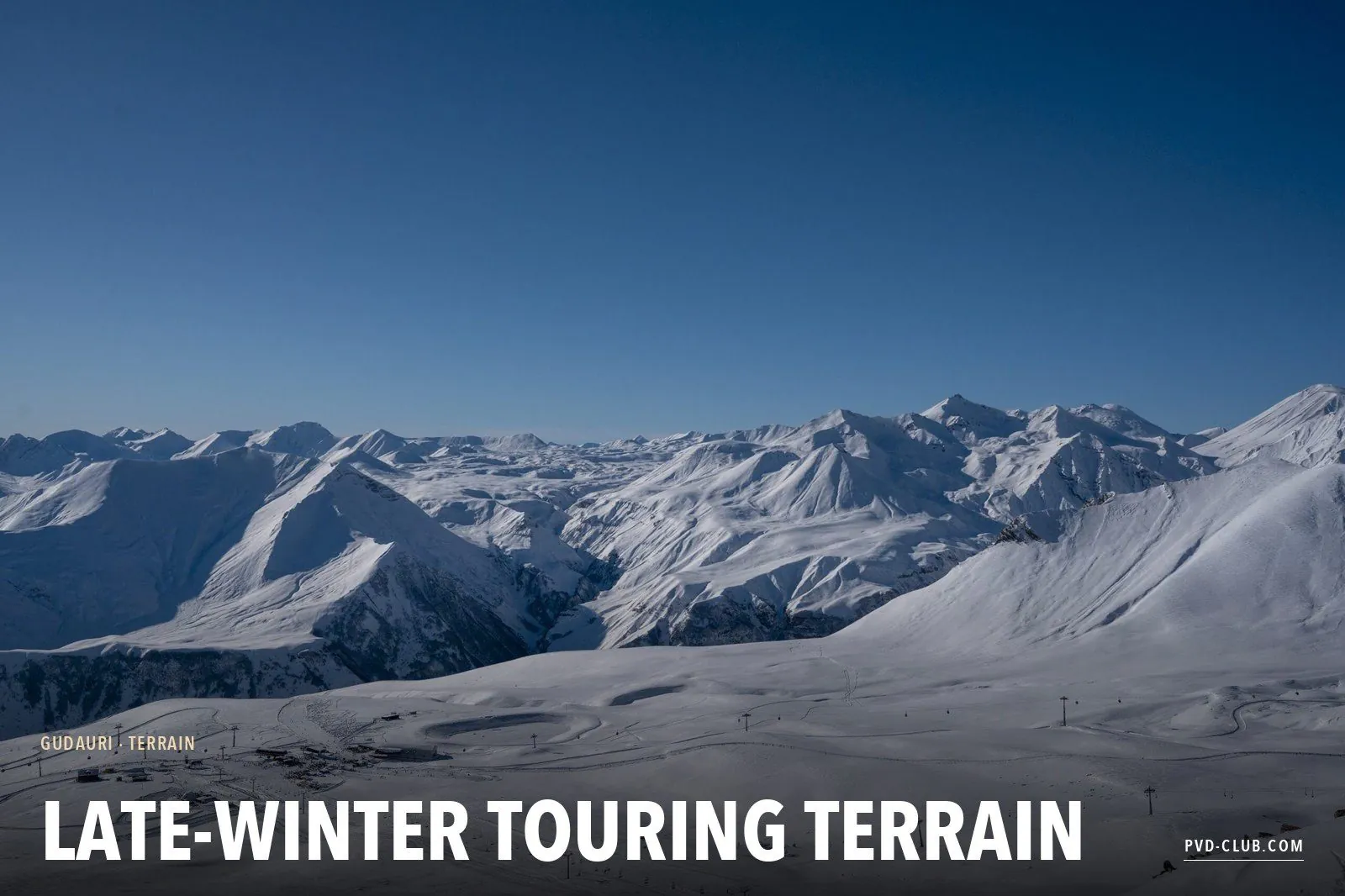
Gudauri is a gift for touring and a trap for overconfidence, in roughly equal measure. The resort sits at about 2,200 metres with the lift-served ridge climbing past 3,000, which means you can be in serious alpine terrain within an hour of the gondola. That accessibility is the point — and the problem. People who have never dug a snowpit find themselves above a loaded bowl before lunch.
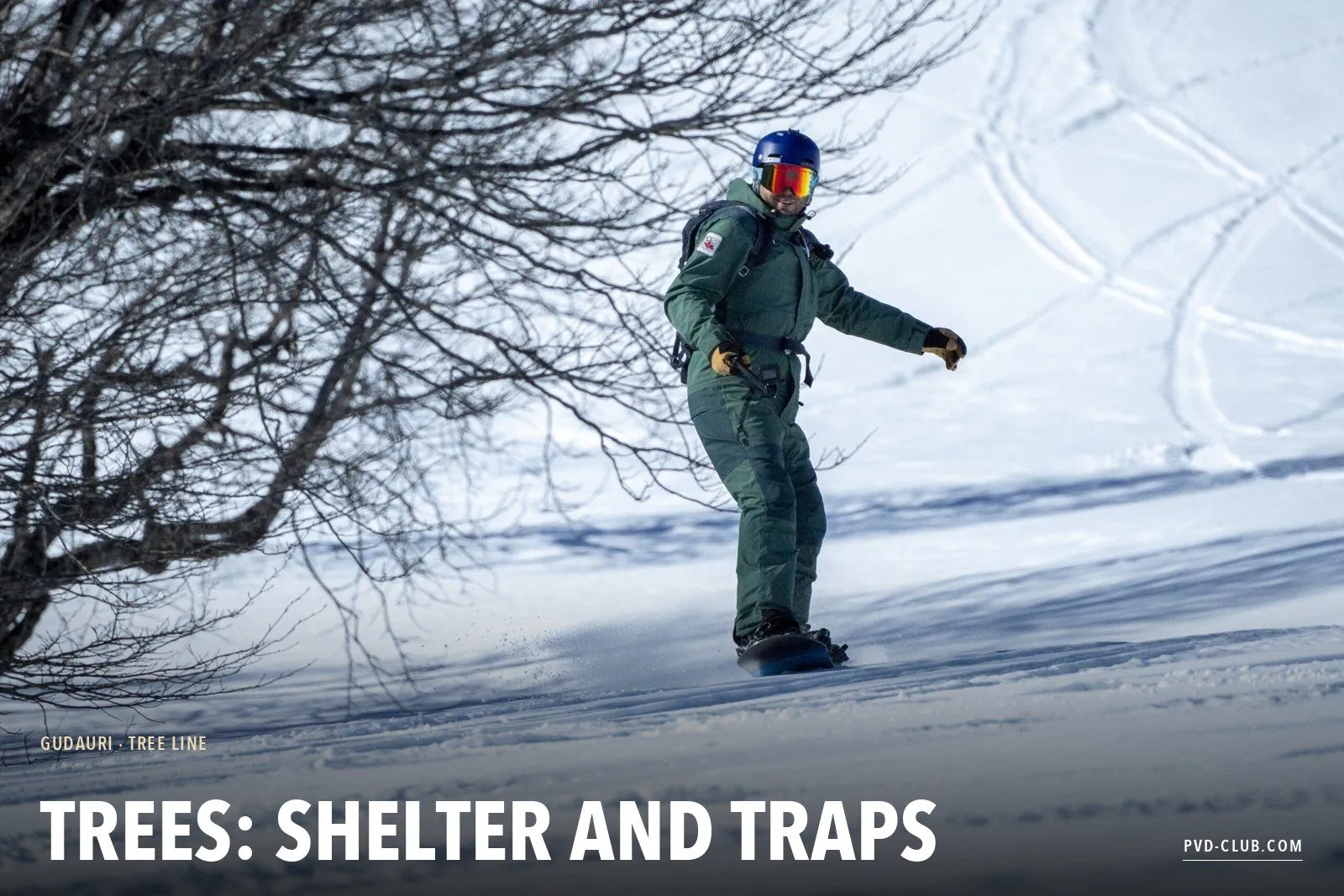
The terrain itself does the rest. The ridge runs west to east, so north faces hold cold dry snow for weeks while south faces crust and corn, and the wind moves snow from one side to the other every time it blows. Cornices build on the lee edges, sometimes far bigger than they look from below. The tree runs lower down are shelter on a storm day and a terrain trap for a solo skier who falls into a well. And the exits are the honest part: some lines drop back to the lifts, and some drop you into a valley that needs another skin, a creek crossing and an hour you did not budget.
Read the terrain before you read the forecast. Our Gudauri off-piste terrain guide walks through the bowls, the trees and the traps zone by zone, and the freeride zones breakdown covers Sadzele, Kudebi, Bidara and Lomisa individually. If you have not yet read either, that is the reading to do before you think about solo objectives.
The Gear That Only Works as a Team
Every gear list for touring says the same thing: transceiver, probe, shovel, worn and switched on. What the lists rarely say is that two of those three are group equipment. A beacon locates a buried person for a rescuer. A probe confirms where the body is under the snow. A shovel moves a cubic metre of debris. None of them helps the person buried, which is exactly the situation a solo skier is signing up for.
That is why the serious solo kit looks different: a satellite messenger with breadcrumb tracking becomes the primary safety device, not the beacon. A helmet and a whistle matter more, because the realistic solo accident is a fall or a tree well, not a full burial. A repair kit matters, because a broken binding at 2,800 metres with no one to help is a genuine emergency. And a hard turnaround time, shared with someone who will actually raise the alarm, matters more than any of it.
Carrying the kit is the easy half. Knowing how to use it takes practice, and practice takes a ski touring partner or two — which is one more reason the «learn it alone» plan does not work. If you are still assembling a setup, start with what ski touring is and what gear you need, and if you ride instead of ski, the splitboarding in Georgia guide covers the equivalent.
If You Go Alone: The Lone Skier's Checklist
Some experienced people will tour alone regardless of advice, and pretending otherwise is dishonest. If that is you, the checklist that keeps you alive is short and non-negotiable.
Treat the ski touring gear checklist as a solo ski touring risk assessment, not a packing list: every item you drop narrows the margin for error. That is exactly why a guided ski tour in Gudauri is not a luxury — it buys back the margin a solo skier cannot create alone.
- Familiar, low-angle terrain only. No new zones, no committing exits, no «let’s see what’s over the ridge» on a solo day.
- Moderate danger or lower. Above that, stay in the resort or stay home. This is not caution for beginners; it is the standard the professionals use.
- A plan left with someone. Exact route, exact turnaround, and a person who knows to call for help rather than assume you are fine.
- A satellite messenger on your body, not in the pack, with tracking on.
- Two hard stops: a turnaround time and a «two red flags» rule. Unstable snow plus worsening weather means down, not on.
- Helmet for the descent, whistle on the chest, repair kit, bivvy bag, two headlamps with spare batteries.
Even with all of that, the honest framing is that you are accepting a risk you cannot mitigate, only reduce. The people best placed to make that call are the ones who have spent years touring with guides and partners first — which is the point of the next section.
What a Guide Actually Changes
Guided ski touring Georgia is not about secret lines. The value of a guide is that they carry the decisions and they have made those decisions hundreds of times on this exact terrain. A local guide reads the snow the night before and again in the morning, knows which slopes the wind loaded overnight, knows which lines are holding cold snow when the obvious ones are tracked, and knows which exit will not eat your daylight.
On a guided day you also get the thing solo skiers lack: a team. Someone to dig a pit while you ski-cut, someone with a beacon who is already on scene if it goes wrong, someone to say «not today» when your judgement is tired. That is the difference between a good day and a good story, and it is why our freeride guide piece is blunt about it.
If you want the structured version, the seven-day freeride camp runs with a maximum of five riders, a guide on the snow every day and evening sessions on snowpack and decisions — the fastest honest route from «I can ski off-piste» to «I can make tour decisions». If you just want one day of it, compare the formats in private guide or group camp. Route specifics for one classic half-day objective are in the Lomisa ridge ski tour guide.
Solo, With a Partner, or Guided: Who Fits What
Not every rider needs a guide for every tour, and pretending otherwise is bad advice. The right choice depends on your experience, the terrain and the conditions. Here is the honest matrix.
| Situation | Best call | Why |
|---|---|---|
| First tours, any terrain | Guided | You do not yet know what you do not know; a guide teaches while keeping you alive |
| Experienced pair, familiar low-angle terrain, moderate danger | Solo team | Two beacons, two opinions, a real rescue capacity |
| Big alpine lines, committing exits, new zone | Guided | Local knowledge is the difference between a line and a trap |
| Anywhere alone, above moderate danger | Don’t | No rescue capacity, no second opinion — the numbers are ugly |
| Storm day, flat light | Guided or resort | Tree navigation and whiteout exits are where people get lost |
The Money Question: Guide Cost vs the Cost of Getting It Wrong
Guided touring costs money, and pretending it is cheap is silly. A guided day or a camp week is a real line item, and it is priced on group size, season and what is included — the honest way to find out is to ask, not to guess from a blog. What is worth comparing it against is not zero. It is the cost of a helicopter evacuation, a hospital stay, a lost season, or worse.
There is also the quieter cost of the unguided route: the years of riding the same safe lines because you never learned to read the ones that are not. A guided week compresses that learning into days. If budget is the deciding factor, the freeride trip cost breakdown puts real numbers on flights, transfers, lodging and lift passes, and the Gudauri ski pass prices page covers the lift side.
Building Toward Independent Touring
The goal for most serious riders is not «guided forever» — it is competent independence. That path has three stages, and skipping any of them is how people end up in the statistics.
Stage one: learn on guided ground. A season of guided days and a formal avalanche course. You learn the snowpack, the terrain and the decision rhythm with someone correcting you.
Stage two: tour with a partner, guided by your own plan. Same familiar zones, conservative objectives, debriefing every day. This is where you build the judgement that solo touring demands — with a safety net.
Stage three: independent, still conservative. Even here, the professionals’ rule holds: big terrain is a team sport. The strongest skiers in this valley tour alone on low-angle familiar ground and take a guide or a partner when the objective gets serious.
Timing matters as much as skill. The best time for freeride and ski touring in Georgia covers when the cover is trustworthy, and the snow by month numbers show how fast the base changes. Getting there is the easy part — see how to get to Gudauri in winter.
Traveler's FAQ
Is it illegal to ski tour without a guide in Georgia?
No. There is no permit or guide requirement for ski touring in Georgia. The mountain does not check your qualifications, which is precisely why the decision is yours to make responsibly.
Can I ski tour alone if I carry a transceiver?
You can carry one, but it will not rescue you. A transceiver lets a partner find you; solo, there is no one receiving. If you tour alone, the satellite messenger and a shared plan matter more than the beacon.
How much experience do I need before touring without a guide?
Realistically: several seasons of off-piste riding, a formal avalanche course, and a stretch of touring with more experienced partners or guides before you lead your own tours. Confidence is not the same as competence.
What is the biggest danger for solo ski tourers in Gudauri?
Avalanches first, then falls and tree wells, then getting lost in flat light. All three share one factor — nobody is there to help — which is why solo is the risk multiplier rather than the risk itself.
Do guided ski tours in Gudauri include avalanche gear?
Most programmes provide or arrange transceiver, probe and shovel, and brief you on their use. Always confirm what is included when you book, and never assume the guide carries spare kit for you.
When is it reasonable to tour without a guide?
Low or moderate avalanche danger, familiar low-angle terrain, a proven partner with a beacon, a plan left with someone, and a hard turnaround. If any of those is missing, the answer is a guided day or the resort.
Final Word
Ski touring without a guide is a skill, not a shortcut. The people who do it well are the ones who spent years learning with guides and partners first, who stick to conservative terrain when the snow is uncertain, and who treat the mountain as a place that does not owe them a summit. If you are not there yet, that is not a failing — it is the normal starting point. Book the guided day, learn the snowpack, and earn the independence properly. The mountain is not going anywhere.